Tucked in the heart of the medina, a few lanes from the souks, the Ben Youssef Madrasa was for centuries one of Marrakech's main Quranic schools, where students came to study Islamic law, theology and religious sciences. Attached to the great Ben Youssef Mosque that gives it its name, it offers visitors today a rare window into traditional teaching and Moroccan decorative art.
The visit focuses on a relatively compact space with remarkably rich decoration: a central courtyard with its basin, covered galleries and, upstairs, former student cells arranged around small inner courtyards. The contrast between the sober volumes and the fine detailing makes it a place appreciated by architecture enthusiasts and casual visitors alike.
A Quranic school in the heart of the medina
A madrasa is a religious teaching institution where students attended lessons given at the neighbouring mosque while lodging on site, in small cells spread across several floors. The Ben Youssef Madrasa operated on this principle: it was not simply a monument but a place of daily life, where students slept, studied and prayed, structured around lesson times and prayers.
It held an important place in the city's intellectual life, directly linked to the Ben Youssef Mosque, one of Marrakech's oldest religious foundations. This proximity between place of worship and place of study illustrates the traditional organisation of religious quarters in major Moroccan cities.
Historical background, told with care
The madrasa's history spans several centuries and several phases of construction and reconstruction, notably under the Saadian dynasty, a period during which the building is believed to have taken much of its current form. As with many Moroccan historical monuments, the exact dates of founding and transformation are debated among historians and local guides: it is best to treat chronological references as general indications rather than firm certainties.
After decades of use and later closure, the building underwent restoration work and reopened to the public as part of efforts to showcase the medina's heritage. To confirm its current opening status and any access restrictions, it is advisable to check an official source before visiting.
The central courtyard and its basin
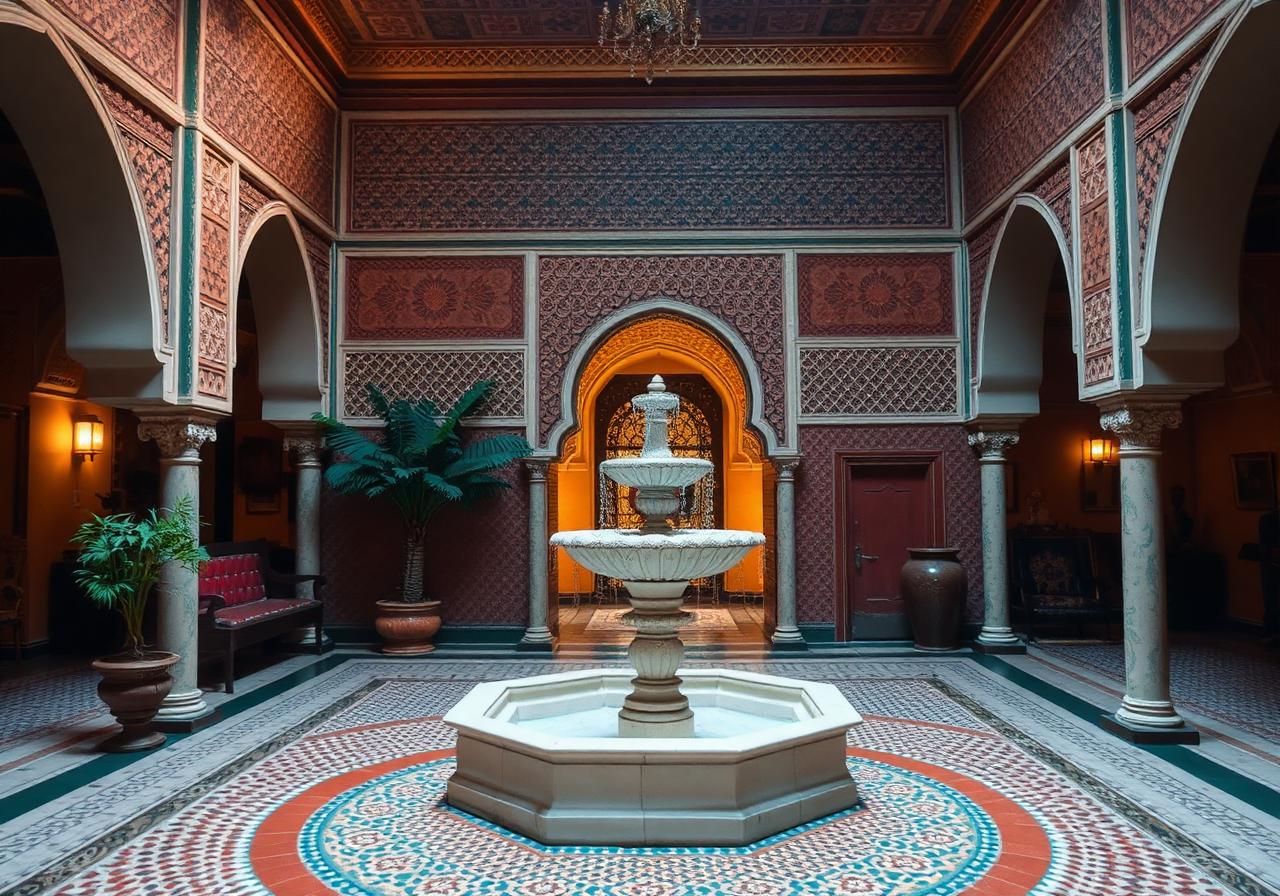
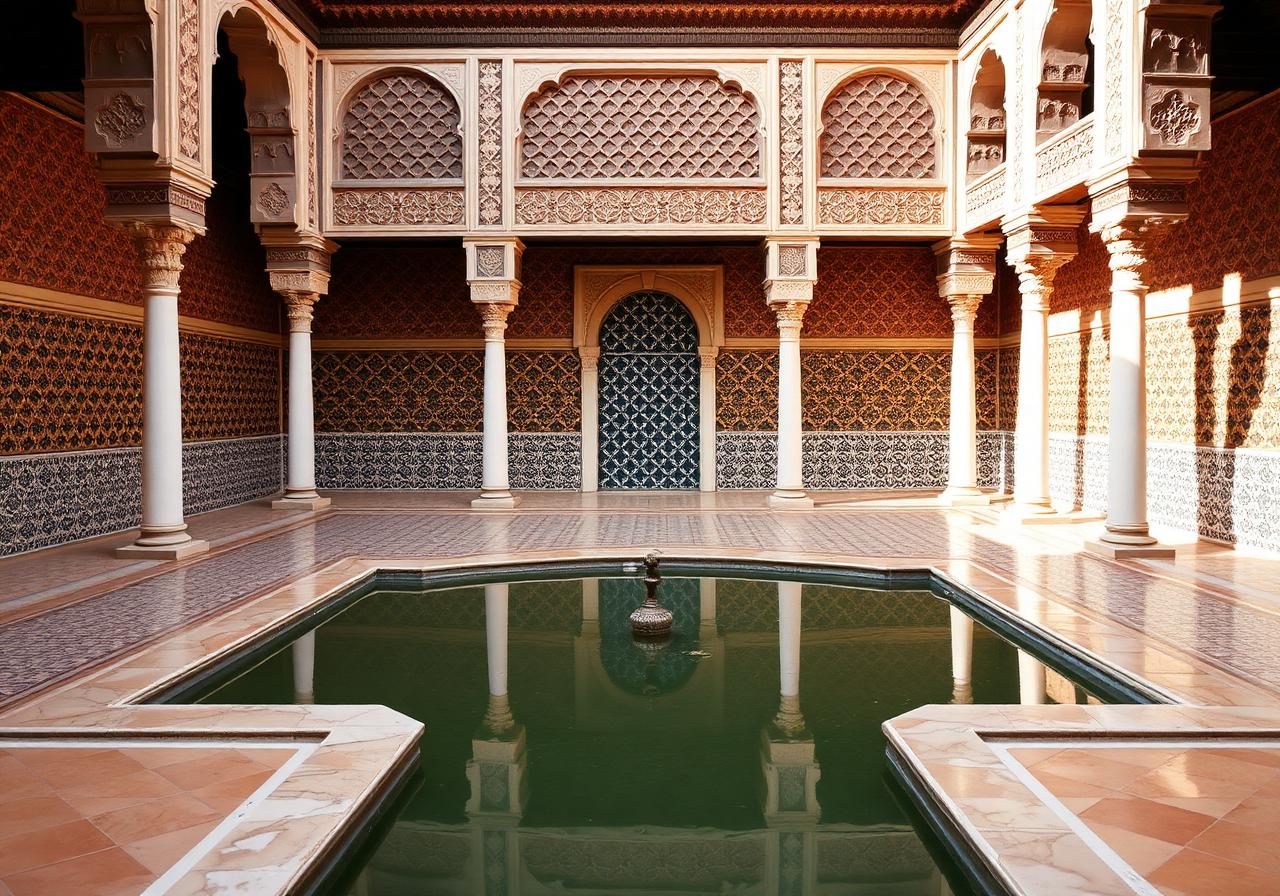
The heart of the visit is the large rectangular courtyard, open to the sky, organised around a marble ablution basin. This courtyard structures the space: the prayer hall sits at one end, while the surrounding galleries give access to the former student cells. The presence of water, a recurring element in traditional Moroccan architecture, serves a ritual function as well as creating the sense of coolness and calm sought in this type of building.
Carved wood, stucco, zellige and calligraphy
- Carved cedar wood: ceilings, cornices and lintels display finely worked geometric and floral motifs typical of Moroccan craftsmanship.
- Carved stucco: the upper wall sections around the arcades are covered with finely carved plasterwork motifs.
- Zellige: coloured geometric ceramic mosaic used on wall bases and the courtyard floor.
- Calligraphic inscriptions: Quranic verses and pious formulas in Kufic and cursive script, integrated into the carved decoration.
Upstairs: the student cells
A narrow staircase leads upstairs, where small cells are arranged around secondary courtyards more intimate than the main one. These sober, modestly sized rooms give a concrete sense of the living conditions of the students who lodged there during their years of study. Some cells have windows overlooking the central courtyard or the inner patios, providing light and ventilation.
What to look at closely
- The symmetry between the arcades framing the courtyard and the central basin.
- The shift from geometric decoration low on the walls (zellige) to floral and calligraphic decoration higher up (stucco, wood).
- The repeated Quranic inscriptions around the arches, often easy to miss without a close look.
- The contrast in scale between the grandeur of the courtyard and the narrowness of the upstairs cells.
Visit duration and best time
A careful visit typically takes between 30 and 45 minutes, a little longer for architecture enthusiasts who want to study the details closely and take photographs. The site tends to draw more visitors in mid-morning and early afternoon; arriving shortly after opening usually allows for a calmer atmosphere and softer light in the central courtyard, though opening hours should be checked with an official source before visiting.
How to get there from Jemaa el-Fna or the souks
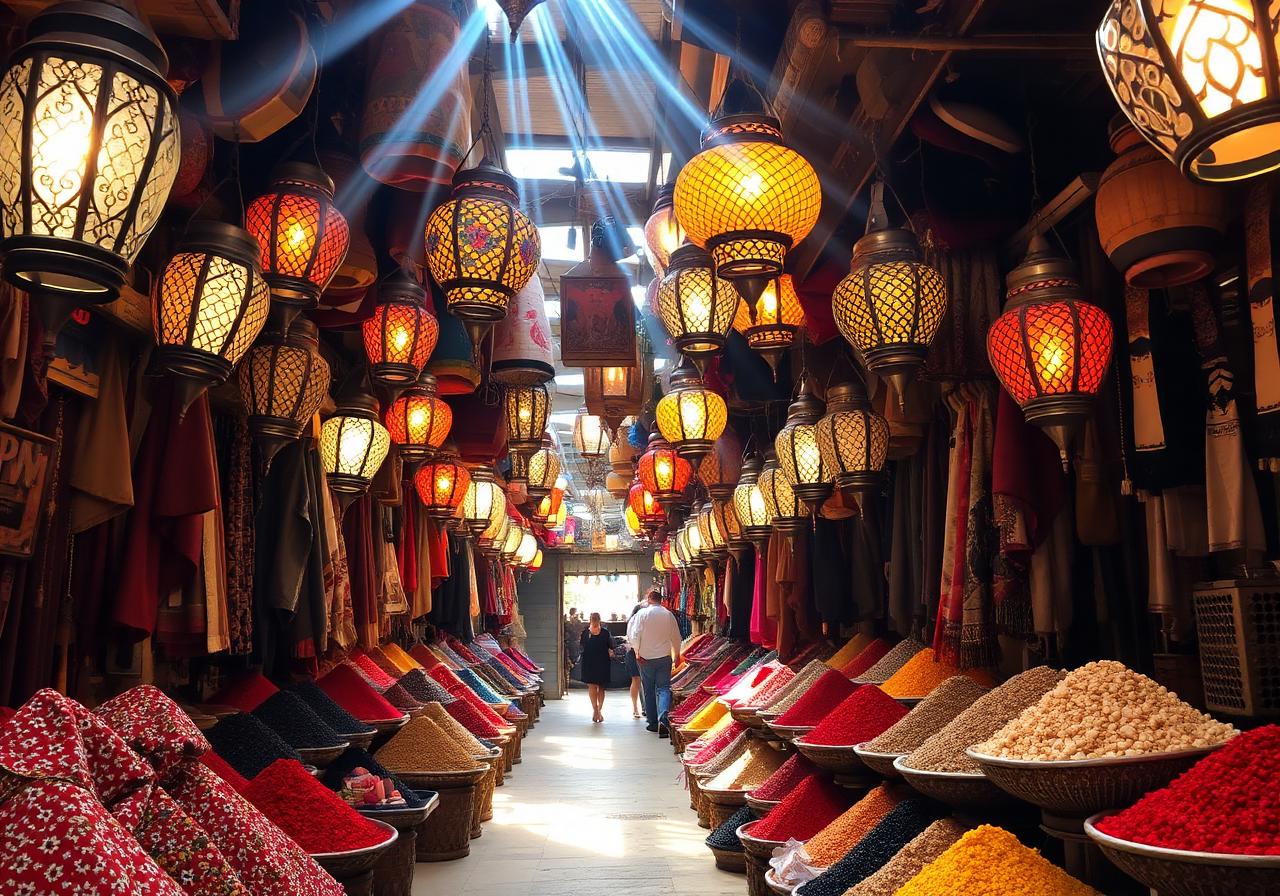
The madrasa lies north of Jemaa el-Fna square, about fifteen minutes' walk through the souks. From the square, head into the commercial lanes going roughly north, keeping the same general direction without straying too far east or west, until reaching the area near the mosque and Ben Youssef square, where the madrasa entrance is signposted. The route crosses several sections of the souks, making it easy to combine shopping with the cultural visit.
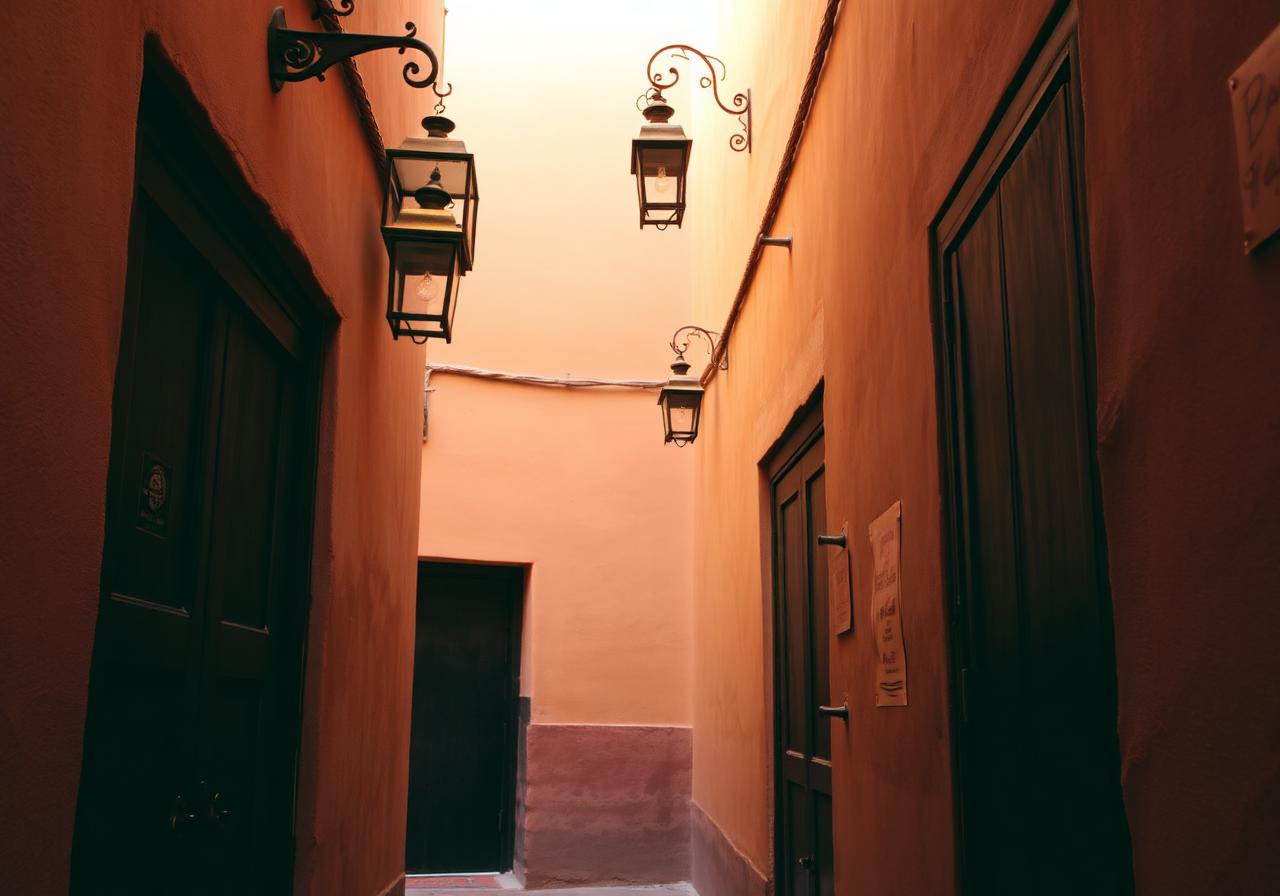
As elsewhere in the medina, the maze of lanes can be disorienting: it helps to follow an offline map on a smartphone or use fixed landmarks such as the Koutoubia or souk signage. The neighbourhood also groups other nearby sites, making it possible to plan a logical loop rather than backtracking.
Accessibility and narrow stairs
The ground floor, organised around the courtyard and galleries, is relatively easy to move through. Access to the upper floor, however, is via a narrow and sometimes steep staircase, not well suited to visitors with reduced mobility or to strollers. Those visitors can still fully enjoy the central courtyard, the prayer hall and the rich decoration of the ground floor without going upstairs.
Visiting with children
The site lends itself reasonably well to a family visit: the open, bright courtyard allows for easy movement, and the geometric patterns can easily become a small observation game for children (spotting repeated shapes, counting the arches). The narrow staircase to the upper floor, however, requires extra care with young children, as there is no continuous railing throughout the upper level.
Nearby sights
- The Marrakech Museum, housed in a nearby former palace just steps from the madrasa.
- The Almoravid Koubba, a rare surviving example of Almoravid architecture, located very close by.
- The surrounding souks, to extend the stroll among the craft stalls.
- Le Jardin Secret, a little further south, for a green pause after the visit.
Common mistakes
- Relying on hours or prices found online without double-checking them before the day of the visit.
- Forgetting to look up: much of the finest decoration is set high, on the cornices and arches.
- Rushing through the visit, when the space, though compact, rewards a calm, unhurried look.
Practical tips
- Wear comfortable shoes: the courtyard floors and the upstairs staircase can be slippery.
- Bring clothing that covers shoulders and knees, as with other heritage sites in the medina.
- Combine the visit with the nearby souks to make the most of the walk.
- Check access conditions and any fees directly with an official source before setting out.
Frequently asked questions
What exactly is the Ben Youssef Madrasa?
It is a former Quranic school linked to the Ben Youssef Mosque, where students lodged and studied under a traditional religious curriculum.
How much time should I allow for the visit?
Generally between 30 and 45 minutes, longer if you want to study the architectural details and take photos.
Are opening hours and prices listed here?
No, because this information changes from time to time. Always check hours and prices with an official source before your visit.
Is the madrasa accessible to visitors with reduced mobility?
The ground floor is fairly easy to visit, but the upper floor is reached only by a narrow staircase, not well suited to visitors with reduced mobility.
How do I get to the madrasa from Jemaa el-Fna?
On foot, in about fifteen minutes, by walking north through the souks to Ben Youssef square and mosque.
Can I visit with young children?
Yes, the ground floor works well, but supervise children closely on the narrow staircase leading upstairs.
What other sights are right nearby?
The Marrakech Museum, the Almoravid Koubba and the surrounding souks are just a few minutes' walk from the madrasa.
Read next
Sources and verification
Discover Marrakech is not an official site. Opening hours, prices, closures and access conditions should be checked with official sources before you travel. Recommendations reflect our own experience, separate from verifiable facts.
- Office National Marocain du Tourisme (ONMT / Visit Morocco)
- UNESCO – Médina de Marrakech, patrimoine mondial
- Ministère de la Culture du Maroc
- Conseil régional du tourisme de Marrakech-Safi
Last editorial review: August 2026
Estimated duration · About 75 seconds
I cannot confirm the exact price or opening hours here. Please check the official page or Google Maps before visiting.