The souks of Marrakech are not just a picturesque backdrop: they form a vast network of trading lanes organised by craft guild, where artisans, wholesalers and local residents have crossed paths for centuries. Knowing how to find your way and how buying actually works changes the whole experience.
This guide describes how the souks are actually organised, the landmarks to avoid getting lost, the best times to visit, what you will genuinely find there, and how to deal with vendors respectfully and calmly, with no invented rules.
What the souks are and how they are organised
The word 'souk' means market, but in Marrakech it actually refers to a maze of covered and open-air lanes north of Jemaa el-Fna square, stretching up towards the Ben Youssef Madrasa. Each sector has historically grouped a specific trade, an organisation inherited from craft guilds.
This trade-based logic still largely holds today, even though some shops now diversify. Understanding this layout helps you know where to look for a specific product rather than wandering at random.
The main zones and their trades
- Semmarine: the main shopping axis just north of Jemaa el-Fna, mixing textiles, babouches, souvenirs and varied shops.
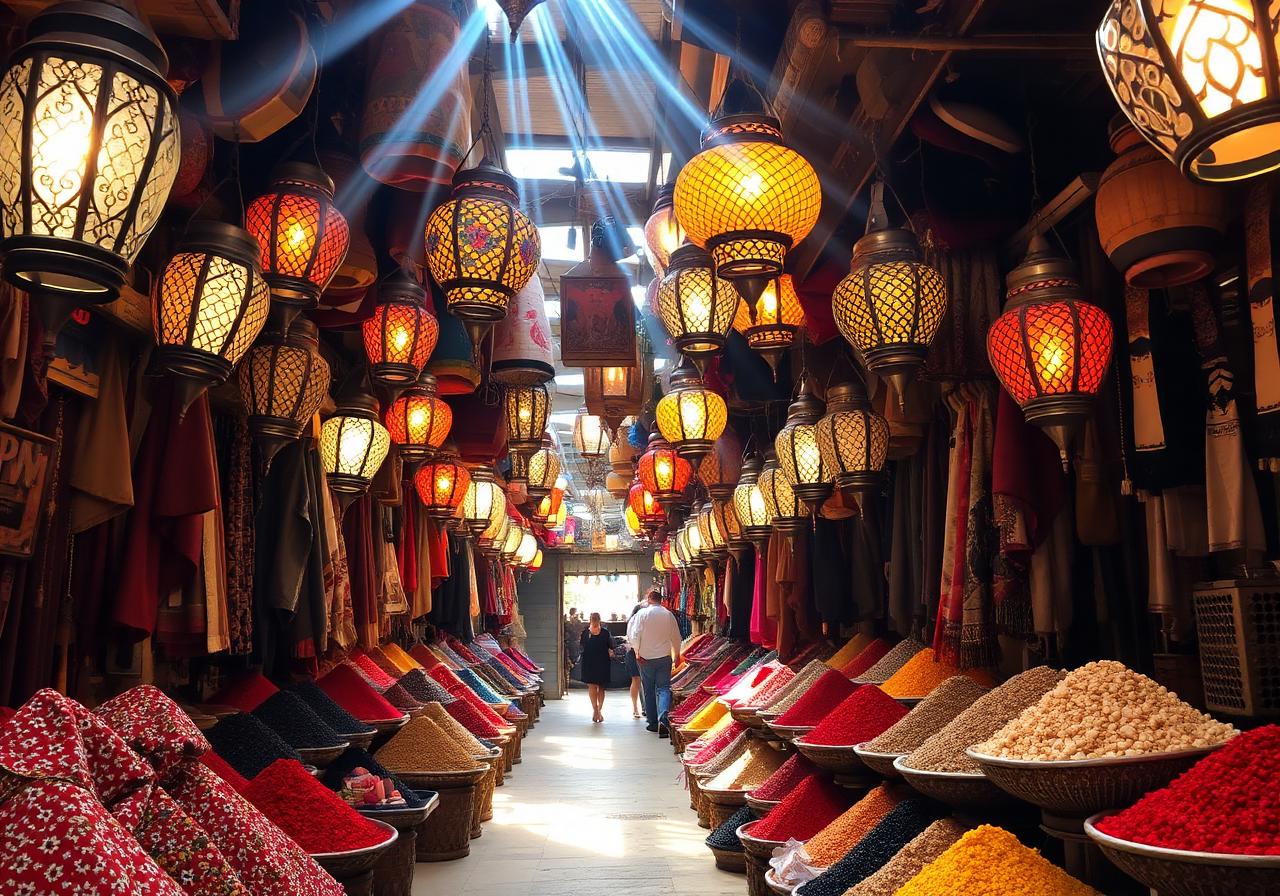
- Souk el Attarine: spices, perfumes, traditional cosmetics and oils, recognisable by its scents.
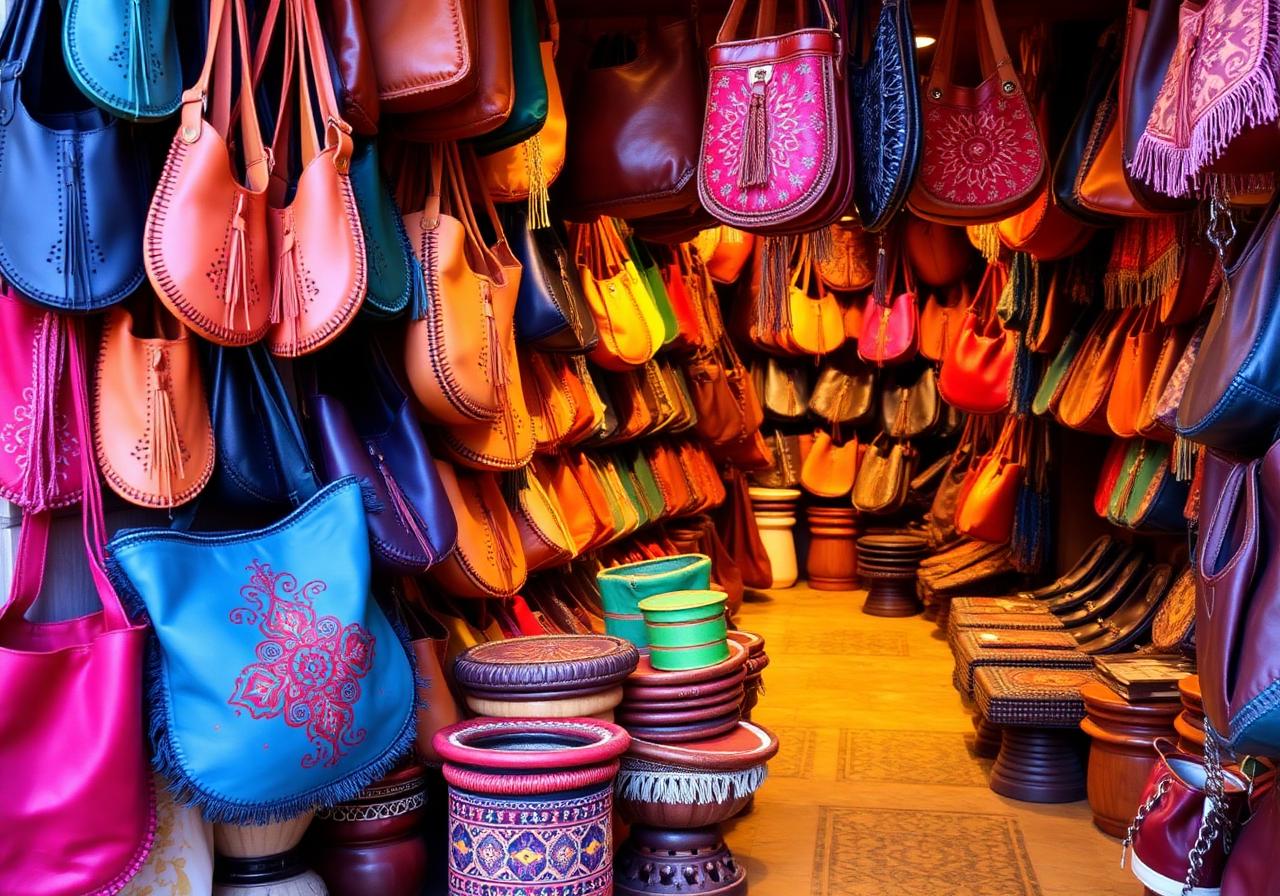
- Cherratine and Smata: leather goods, bags, belts and small saddlery items.
- Haddadine: metalwork, ironmongery and lanterns, where craftsmen's hammers can be heard.
- The dyers' souk (Sebbaghine): skeins of wool and thread hung out, freshly dyed.
- The Criée Berbère and carpet sector: a historic auction area for Berber carpets and textiles.
- The lanes for babouches, basketry and woodwork: lanterns, marquetry boxes, baskets and carved objects.
Orientation: entering and finding your way in the souks
The simplest way in is from Jemaa el-Fna, heading north up the covered Semmarine axis. Walking as straight as possible, you eventually reach the Ben Youssef Madrasa, an excellent fixed landmark to reorient yourself or set a mental return point.
GPS apps often drift once inside the souks: covered lanes cut the signal, and digital maps do not always detail the secondary passages. It is better to rely on visual landmarks — a doorway, the colour of certain goods, a distinctive crossroads — than on the phone screen.
If in doubt, heading back down to a wide, familiar axis, such as the one leading to Jemaa el-Fna, remains the most reliable solution. The guide on the medina without stress details further complementary orientation methods.
Jemaa el-Fna and Ben Youssef, two anchor points
Any exploration of the souks benefits from being framed between these two landmarks. Jemaa el-Fna, to the south, offers an immediate exit to an open, familiar space; the Ben Youssef Madrasa, to the north, marks a clear boundary beyond which the trading lanes give way to more residential quarters.
Setting one of these two points as your final goal greatly simplifies the walk, even if you take an improvised detour down an appealing lane.
The best times to visit
Early in the morning the souks are calmer: metal shutters go up gradually, low light filters through the reed screens overhead, and it is easier to watch craftsmen at work before the crowds build. By midday, footfall rises noticeably, especially along the touristic axes.
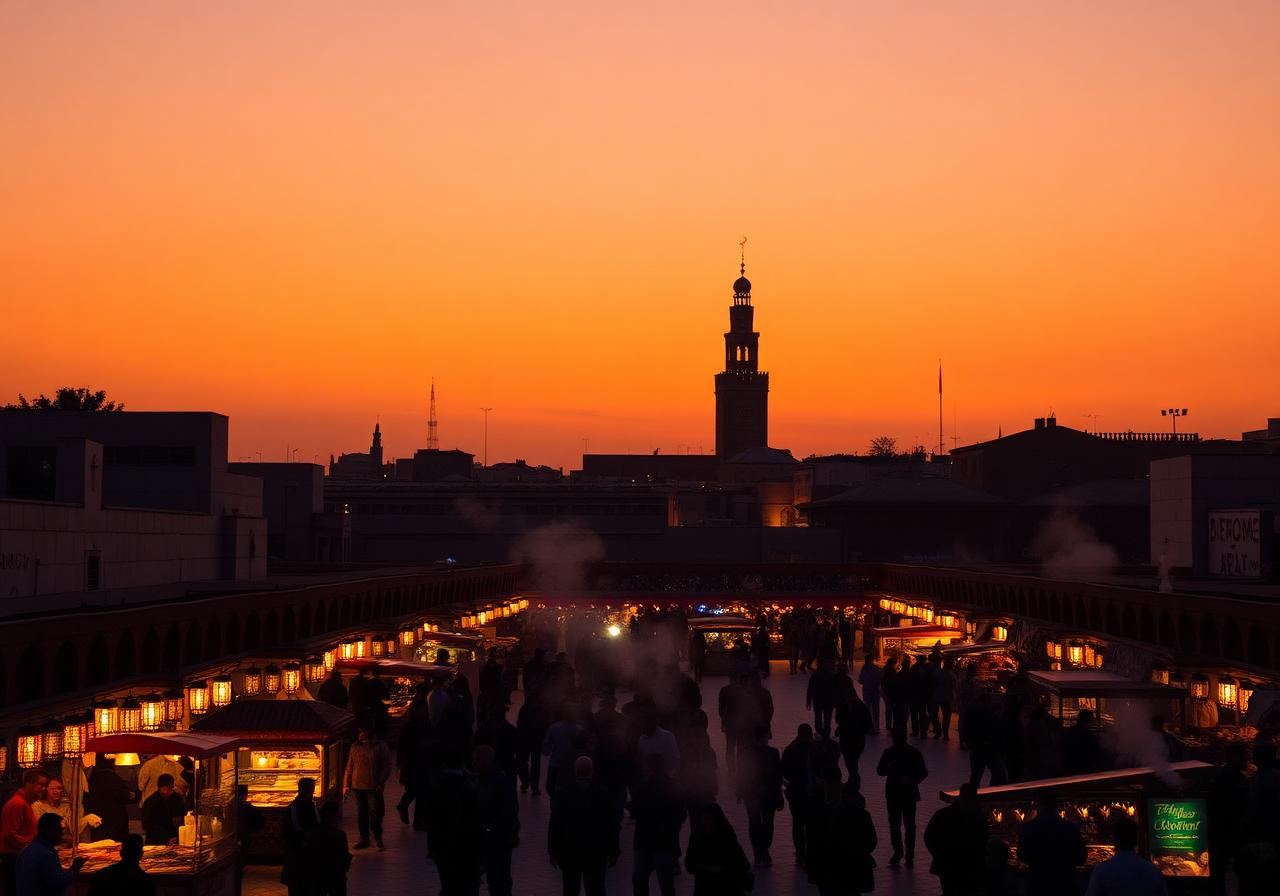
In the late afternoon and early evening, the atmosphere becomes lively and convivial again, with soft light that is good for photos. On Friday afternoon, the weekly prayer time for many shopkeepers, some shops close temporarily, which makes certain lanes quieter.
What you will find and how to judge quality
Leather can partly be judged by its smell, its flexibility and the regularity of the stitching; a very stiff item or coarse seams deserve closer inspection. For carpets, the difference between wool and synthetic fibres is often felt by touch and by how light catches the fibres — asking about origin and composition remains the best approach, without absolute certainty guaranteed by appearance alone.
Authentic argan oil and saffron have a real production cost, tied to harvesting and processing time; an abnormally low price calls for caution and questions rather than quick conclusions. Pierced metal lanterns vary greatly in the fineness of the cutwork and the thickness of the metal, which is visible to the naked eye when comparing several pieces. Ceramics can be judged by the evenness of the glaze and the absence of cracks.
Bargaining: a conversation, not a magic formula
In many souk shops, the price first quoted or displayed is not fixed and can be discussed. However, there is no universal rule — no fixed percentage, no magic method — because it depends on the product, the craftsmanship it represents, the shop and the moment's context.
The healthiest approach is to do a little research beforehand, compare several shops for the same type of item, and engage in the conversation courteously, keeping in mind that it is an exchange between two people, not a confrontation. The dedicated guide on souk bargaining develops this approach in more detail.
Asking a price, looking, negotiating and accepting: the nuances
Asking 'bchhal hada' (how much is this) commits you to nothing: it is simply gathering information. Looking at and handling an item without an immediate intention to buy is also common and generally well received, especially if kept brief and respectful of the vendor's time.
Active negotiation, however, begins once you propose a price yourself: it signals genuine interest. Once an amount is accepted by both sides, saying 'yes' or 'safi' (that's enough, agreed) is a strong moral commitment — backing out afterwards is seen as discourteous. It is therefore better to be sure of your choice before concluding.
Payment, cash and withdrawals
Cash payment remains widely dominant in the souks, including among many small craftsmen and independent vendors. Bank cards are accepted in some more established shops, but not everywhere, so it is better not to rely on them entirely during a shopping session in the covered lanes.
Carrying small change makes modest purchases easier, as shopkeepers do not always have change for large notes. ATMs are found outside the covered lanes, usually on the wider streets of the medina or in the immediate surroundings — so it is more practical to withdraw cash before entering the souks than to look for one once inside.
Bulky purchases and shipping
Some purchases, such as a large carpet, a piece of furniture or several lanterns, raise the question of transport. Some shops offer their own shipping arrangement; in that case it is reasonable to ask for clear details on timing and terms before committing, and to keep any proof of purchase.
There is no single official shipping service to recommend, and each situation deserves to be assessed case by case according to the specific offer made by the vendor on the day.
Finding your way back and exiting the souks
If your sense of direction becomes confused, looking for natural light and ambient noise often helps locate a wider street. Following the main flow of passers-by, rather than an isolated, quiet lane, generally leads back to a known axis such as Semmarine or the area around the Ben Youssef Madrasa.
Politely asking a shopkeeper for directions also remains a simple and generally effective option.
Visiting the souks with children
The souks can captivate children with their colours, smells and lively atmosphere, but the density of foot traffic and the narrowness of some lanes require constant vigilance. Holding younger children's hands in the busiest passages and agreeing on a common landmark in case of accidental separation are useful precautions, as detailed in the guide on Marrakech with children.
Accessibility and moving through the lanes
The ground in the souks is often uneven, paved or of packed earth, with occasional steps and natural light filtered by the overhead reed screens. Hand-pulled carts and sometimes motorbikes move through some lanes, which calls for staying alert and moving without rushing.
These conditions make the visit more demanding for people with reduced mobility or using a wheelchair; it is useful to identify in advance the widest, most walkable axes rather than the narrowest side lanes.
Persistent vendors and unsolicited guiding
Vendors may sometimes call out to passers-by, or people may spontaneously offer to guide you to a particular shop or place. This insistence often stems from a highly competitive local economy rather than ill intent. Responding calmly with a polite but firm 'la choukran' (no thank you), or a simple smile followed by a decisive step forward, is usually enough to close the exchange without tension.
There is no need to over-justify a refusal or to accept unsolicited guidance out of excessive politeness. The guide on the medina without stress offers further tips for handling these situations calmly.
Common mistakes to avoid
- Relying solely on phone GPS in the covered lanes instead of visual landmarks.
- Accepting a price hastily before comparing a few similar shops.
- Saying 'yes' to an offer while still hesitating, which creates a misunderstanding about the commitment made.
- Not carrying cash, assuming cards will be accepted everywhere.
- Getting drawn into a long unsolicited guiding conversation out of mere politeness, with no real intention of following it up.
A few useful phrases in French and Darija
- Hello = 'salam' (sa-lam): a simple greeting, always welcome when entering a shop.
- No thank you = 'la choukran' (la shoo-krahn): a polite refusal understood by everyone.
- How much is this = 'bchhal hada' (b-shhal ha-da): the basic question to start the conversation.
- That's enough / okay = 'safi' (sa-fee): marks the end of a negotiation or exchange.
- Just looking = 'chouf ghir' (shoof gheer): useful for signalling that you have no immediate intention to buy.
- Thank you very much = 'choukran bezzaf' (shoo-krahn bez-zaf): a warm polite phrase at the end of an exchange, even without a purchase.
Frequently asked questions
How do I enter the souks from Jemaa el-Fna?
By heading north up the covered Semmarine axis, just north of the square, towards the Ben Youssef Madrasa, which serves as a final landmark.
How do I avoid getting lost in the souks?
By relying on fixed visual landmarks such as Jemaa el-Fna and the Ben Youssef Madrasa rather than GPS, which often drifts under the covered lanes, and heading back to a wide axis if in doubt.
How do I negotiate a price in the souks?
By engaging in a courteous conversation, comparing several shops, and keeping in mind that there is no fixed rule: it all depends on the product and the situation. Saying 'yes' or 'safi' seals a final agreement.
What can you buy in the Marrakech souks?
Leather goods, spices and perfumes, carpets, metal lanterns, ceramics, basketry and wooden objects, with each zone specialising in a particular craft.
Are bank cards accepted in the souks?
Some established shops accept them, but cash remains widely dominant; it is better to bring cash and small change before entering.
Where can I find an ATM near the souks?
Outside the covered lanes, on the wider streets of the medina or in the immediate vicinity; it is more practical to withdraw cash before entering the souks.
How should I respond to an insistent vendor?
Calmly and with polite firmness, for example a 'la choukran' followed by a smile and a decisive step forward, without needing to over-justify.
Are the souks suitable for visiting with children?
Yes, with vigilance: hold younger children's hands in busy passages and agree on a common landmark in case of separation.
Read next
Sources and verification
Discover Marrakech is not an official site. Opening hours, prices, closures and access conditions should be checked with official sources before you travel. Recommendations reflect our own experience, separate from verifiable facts.
- UNESCO – Médina de Marrakech, patrimoine mondial
- Office National Marocain du Tourisme
- Ministère du Tourisme, de l'Artisanat et de l'Économie Sociale et Solidaire
- Conseil régional du tourisme de Marrakech
Last editorial review: August 2026
Estimated duration · About 75 seconds
I cannot confirm the exact price or opening hours here. Please check the official page or Google Maps before visiting.